Right here’s my 2026 1st Quarter earnings replace as a companion publish to my 2026 1st Quarter asset allocation & efficiency replace. Though I don’t concentrate on high-dividend shares or covered-call methods, I nonetheless observe the earnings from my portfolio instead metric to cost efficiency. The whole earnings goes up rather more steadily and persistently than the quantity proven on brokerage statements, which helps encourage constant investing. Right here’s a quote from Jack Bogle (supply):
The true investor will do higher if he forgets in regards to the inventory market and pays consideration to his dividend returns and to the working outcomes of his corporations. – Jack Bogle
Inventory dividends are a portion of earnings that companies have determined to distribute on to shareholders, versus reinvesting into their enterprise, paying again debt, or shopping for again shares. They’ve explicitly determined that they don’t want this cash to enhance their enterprise, and that it might be higher to distribute it to shareholders. The dividends could endure some short-term drops, however over the long term they’ve grown quicker than inflation.
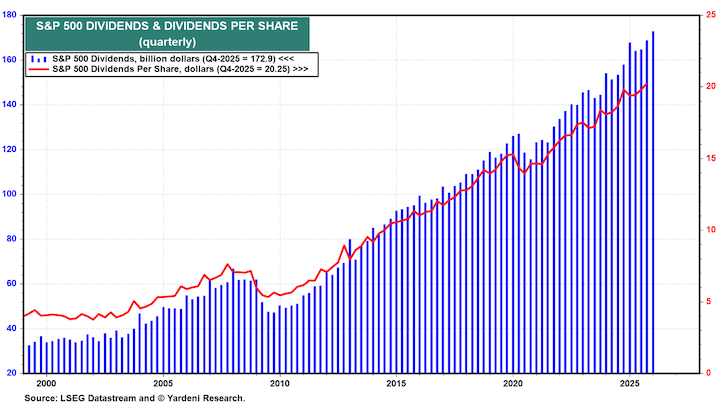
Right here is the historic progress of the S&P 500 whole dividend, which tracks roughly the most important 500 shares within the US, up to date as of 2026 Q1 (by way of Yardeni Analysis):
Monitoring the earnings from my portfolio. Three of the first “bushes” that produce “fruit” in my portfolio are Vanguard Complete US Inventory ETF (VTI), Vanguard Complete Worldwide Inventory ETF (VXUS), and Vanguard Actual Property Index ETF (VNQ).
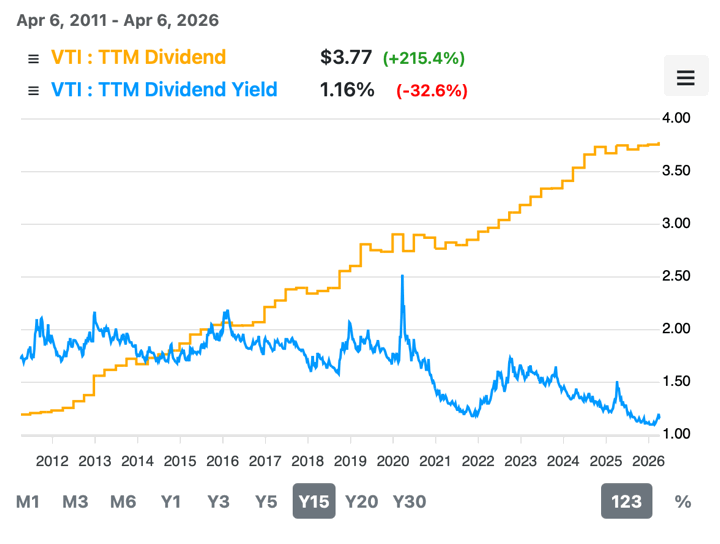
Within the US, the dividend tradition is considerably conservative in that shareholders anticipate dividends to be steady and solely go up. Thus the beginning yield is decrease, however grows extra steadily with smaller cuts throughout exhausting instances. Corporations do buybacks as effectively, actually because they’re simpler to discontinue. Right here is an up to date chart of the trailing 12-month (ttm) dividend per share during the last 15 years paid by the Vanguard Complete US Inventory ETF (VTI) by way of WallStNumbers.com.
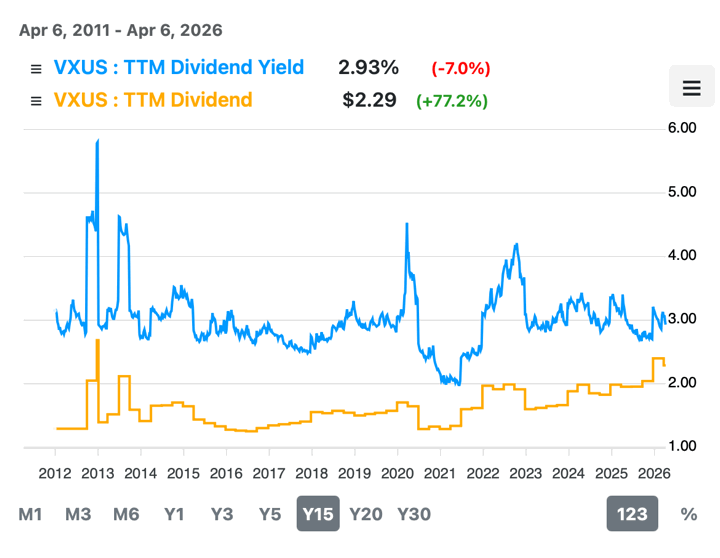
European company tradition tends to encourage paying out the next (typically even fastened) share of earnings as dividends, however that additionally means the dividends transfer up and down with earnings. The beginning yield is presently greater however could not develop as reliably. Right here is an up to date chart of the trailing 12-month (ttm) dividend per share during the last 15 years paid by the Vanguard Complete Worldwide Inventory ETF (VXUS).
Within the case of Actual Property Funding Trusts (REITs), they’re legally required to distribute not less than 90 p.c of their taxable earnings to shareholders as dividends. Traditionally, about half of the full return from REITs is from this dividend earnings. Right here is an up to date chart of the trailing 12-month (ttm) dividend per share during the last 15 years paid by the Vanguard Actual Property Index ETF (VNQ).
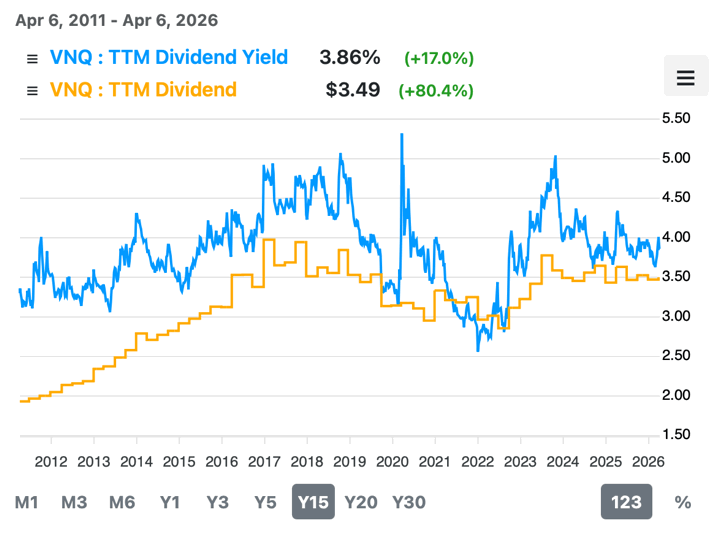
The dividend yield (dividends divided by worth) additionally function a tough valuation metric. When inventory costs drop, this share metric normally goes up – which makes me really feel higher in a bear market. When inventory costs go up, this share metric normally goes down, which retains me from getting too euphoric throughout a bull market.
Lastly, the final earnings part of my portfolio comes from curiosity from bonds and money. Vanguard Quick-Time period Treasury ETF (VGSH) and Schwab US TIPS ETF (SCHP) are instance holdings, with the precise quantity various with the prevailing rates of interest, the actual charges on TIPS, and the present charge of inflation.
Dividend and curiosity earnings yield. To estimate the earnings from my portfolio, I take advantage of the weighted “TTM” or “12-Month Yield” from Morningstar (checked 4/8/26), which is the sum of the trailing 12 months of curiosity and dividend funds divided by the final month’s ending share worth (NAV) plus any capital positive factors distributed (normally zero for index funds) over the identical interval. My TTM portfolio yield is now roughly 2.61%.
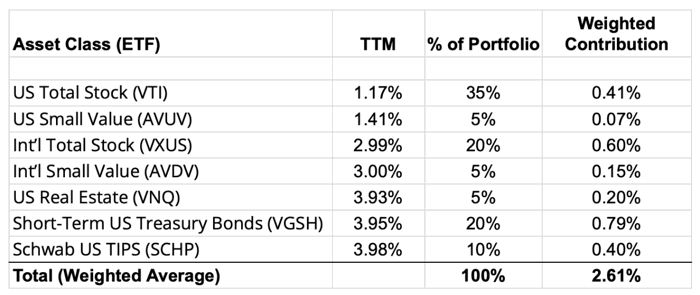
In dividend investing circles, there’s a metric referred to as yield on value, which is calculated by dividing the present dividend by the unique buy worth. In different phrases, whereas my portfolio yield in the present day is could also be decrease than say a goal withdrawal charge of three%, that’s as a result of the present market worth can be so much greater. Because of rising dividends on common over time, my yield-on-cost based mostly on my portfolio worth from 10 years in the past is over 5%.
What in regards to the 4% rule? For large-picture functions, I help the easy 4% or 3% rule of thumb, which equates to a goal of accumulating roughly 25 to 33 instances your annual bills. I might lean in direction of a 3% withdrawal charge if you wish to retire younger (nearer to age 50) and a 4% withdrawal charge if retiring at a extra conventional age (nearer to 65). It’s only a fast and soiled goal to get you began, not a quantity despatched down from the heavens!
Through the accumulation stage, your time is best spent specializing in incomes potential by way of higher profession strikes, bettering your skillset, networking, and/or searching for asymmetrical (limitless upside, restricted draw back) entrepreneurial alternatives the place you may have an possession curiosity.
Our dividends and curiosity earnings aren’t robotically reinvested. They’re merely one other “paycheck”. As with our different variable paychecks, we are able to select to both spend it or make investments it once more to compound issues extra shortly. You might use this cash to chop again working hours, pursue a special profession path, begin a brand new enterprise, take a sabbatical, carry out charity or volunteer work, and so forth. You don’t have to attend till you hit a magic quantity. Our life path has been very completely different due to this philosophy. FIRE is Life!