Perhaps the reopening of the Strait of Hormuz is the ticket to decrease mortgage charges.
In any case, that’s primarily what precipitated them to leap about 75 foundation factors because the finish of February.
There was actually no different rationalization for the abrupt rise in mortgage charges over the previous few months.
So if we’re capable of unravel that transfer through regular transit by the important thing waterway, mortgage charges ought to logically return to these ranges.
If that’s certainly the case, we might ultimately get again to a sub-6% 30-year fastened once more.
Decrease Oil Costs Give Mortgage Charges a Push Down
Because of the accord within the Center East, oil costs are actually again to pre-war ranges.
Brent crude futures fell to under $74 per barrel, which is the bottom ranges because the U.S. and Israel launched airstrikes on Iran in late February.
Comparable drops have been seen with WTI oil futures, although that didn’t cease President Trump from complaining on social media that oil firms haven’t lowered gasoline costs rapidly sufficient.
And that really brings up a very good level. It’s going to take time for the multi-month disruption to work itself out.
The Strait of Hormuz was successfully closed for about 3 and ½ months throughout the battle.
There’s a whole lot of backlog and logistical stuff that must be sorted out to get us again to sq. one.
Even then, there may nonetheless be a premium baked in to grease costs and mortgage charges to account for the brand new threat of future closures.
In different phrases, whereas it’s excellent news that issues are normalizing and oil costs are down, mortgage charges won’t return to these low ranges seen on the finish of February.
Because it stands, the 30-year fastened is priced round 6.50% due to at the moment’s transfer decrease, however stays about 50 foundation factors (bps) above the pre-war lows.
Is Oil the Solely Key Issue for Mortgage Charges?
Whereas I’ve argued that the rise in mortgage charges this 12 months has just about boiled down to at least one factor, the conflict, issues are all the time in flux.
Mortgage charges don’t exist in a vacuum and could be affected by myriad elements, that are continuously altering.
Working example, whereas the conflict was happening, there have been rising considerations that the tech trade has overheated.
We’ve seen shares surge regardless of the conflict and the $100 per barrel oil, seemingly ignoring geopolitics in favor of huge returns.
This has precipitated many to sound the alarm that issues are getting frothy once more, with valuations rivaling the dot com growth and bust period.
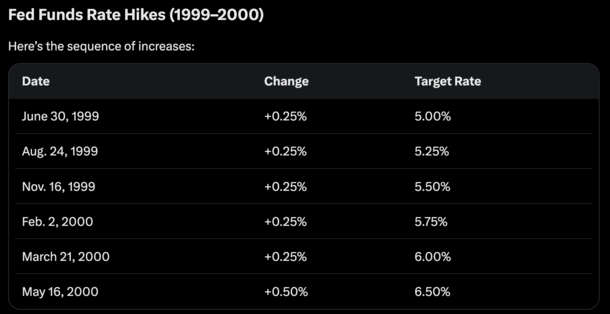
There are actually some parallels between now and the late Nineties. Again then, the Fed started a mountaineering marketing campaign in mid-1999 to chill issues off.
They raised the fed funds fee six occasions, together with a 50-basis level hike in Could 2000 after the inventory market had peaked.
Maybe that can occur once more this cycle, although because it stands, there’s just one attainable 25-bp hike on the desk for the 12 months.
Nonetheless, that places some upward stress on mortgage charges past simply the vitality disaster that’s apparently sorting itself out.
So taken collectively, we’ve received some upside threat resulting from sky-high tech valuations, together with some baked in threat related to geopolitics.
That might make it troublesome for the 30-year fastened to get again to under 6% once more anytime quickly.
Although if the peace deal holds up and we will no less than transfer on from Iran, that might get mortgage charges on the correct facet of 6.50% once more.
Learn on: Check out my mortgage fee calculator to match completely different charges and funds quick!

Earlier than creating this website, I labored as an account government for a wholesale mortgage lender in Los Angeles. My hands-on expertise within the early 2000s impressed me to start writing about mortgages 20 years in the past to assist potential (and present) house patrons higher navigate the house mortgage course of. Comply with me on X for warm takes.